

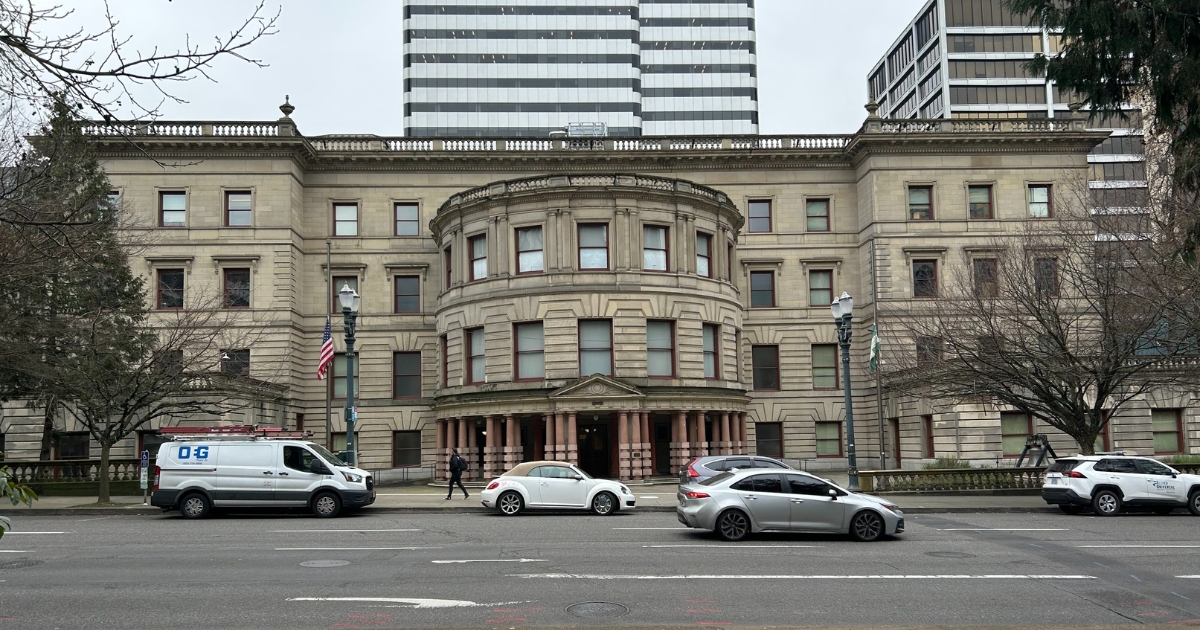
PORTLAND, OR — The Portland City Council unanimously approved a new municipal policy Tuesday evening after reaching rare and sustained agreement on one key point: the situation is complicated. The policy passed without objection, clarification, or a clear understanding of what it will actually do.
Council members described the decision as “necessary,” “thoughtful,” and “reflective of where we are right now,” though none were able to summarize the policy in fewer than four sentences, and several stopped mid-explanation to acknowledge nuance.
“This was not an easy decision,” said one council member, pausing carefully. “But it felt like the right kind of complicated.”
A Policy Built on Consensus, Not Clarity
The policy, which took over six months to draft, review, revise, and emotionally workshop, originated from a task force formed to study an issue that had already been studied previously. The resulting document spans 86 pages, includes three flowcharts, and avoids definitive language wherever possible.
Rather than prescribing specific actions, the policy establishes a framework for “ongoing consideration,” “adaptive response,” and “future alignment,” all to be determined later.
City staff confirmed that while the policy is now officially in effect, implementation will depend on further guidance, additional funding, and a shared understanding that may or may not emerge.
“It’s not about immediate outcomes,” explained a policy analyst. “It’s about acknowledging complexity in an official capacity.”
How the Decision Was Reached
The council meeting itself lasted just under five hours, though only the final 20 minutes involved voting. The rest was dedicated to contextualizing the vote.
Council members spoke at length about lived experience, historical context, overlapping jurisdictions, and the importance of not oversimplifying something that deserves to remain unresolved for a while.
At several points, members nodded simultaneously, signaling agreement without requiring specifics. Applause broke out when one speaker concluded, “There are no easy answers,” a statement later referenced in the meeting minutes.
Public Comment Reflects the Mood
During public comment, residents largely echoed the council’s tone. Speakers described feeling conflicted, cautiously supportive, and unsure how the policy would affect them personally.
“I don’t fully understand it,” said one resident who waited nearly two hours to speak. “But I respect the process.”
Another speaker asked whether the policy would change anything in their neighborhood. The question was noted for future consideration.
Several commenters thanked the council for “sitting with the discomfort,” while others requested that the city eventually provide a summary that is “both accurate and gentle.”
City Officials Attempt Explanation
After the vote, city officials released a statement confirming the policy’s approval and emphasizing that its strength lies in flexibility.
“This policy allows us to respond thoughtfully without committing prematurely to a specific course of action,” the statement read. “It gives us room.”
When asked what success would look like, a spokesperson said it would be “recognizable when it happens,” though no timeline was provided.
Officials reassured residents that metrics are being developed, though they will likely be qualitative, evolving, and subject to interpretation.
Residents React Carefully
Across Portland, residents responded with cautious optimism. Some expressed relief that the city was finally doing something, even if that something remained abstract.
“I’m glad they acknowledged it’s complicated,” said a resident in Southeast Portland. “That feels honest.”
Others admitted they were unsure whether the policy addressed their concerns but appreciated the tone. “It didn’t feel rushed,” one North Portland resident said. “And that matters.”
Local advocacy groups issued statements of support, clarifying that while the policy may not go far enough, it does not go too far either.
What Happens Now
According to city officials, the next steps include forming a working group to interpret the policy, followed by a listening phase to assess how the policy is being perceived. A pilot program may be introduced once the city feels ready.
In the meantime, departments have been instructed to “act in alignment with the policy’s intent,” even if that intent remains broadly defined.
Printed copies of the policy will be made available upon request, though officials recommend reading it “in parts.”
A Very Portland Outcome
As the meeting adjourned, council members thanked one another for their patience and vulnerability. No one declared victory. No one expressed certainty.
“It’s complicated,” one member said again, this time with a small smile.
The motion passed unanimously.