

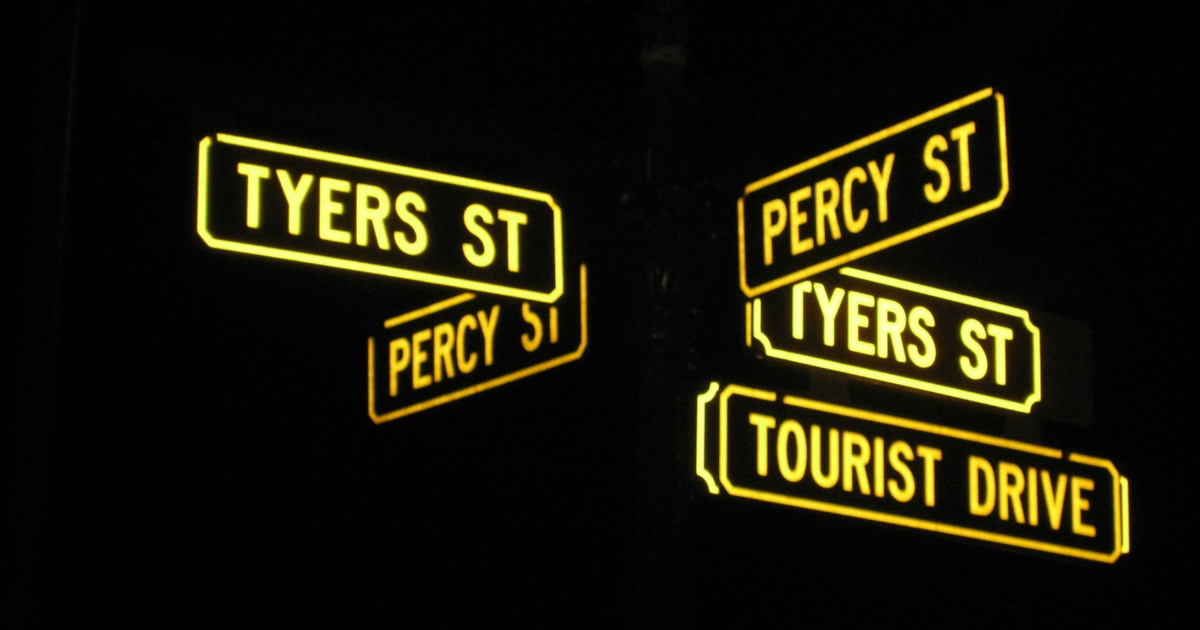
New observations along NE Alberta Street, near Overlook Park, and around Tilikum Crossing suggest many Portland cyclists now rely on sustained eye contact as an informal traffic coordination system.
PORTLAND, OR — A new transportation behavior study released this week found that a majority of Portland cyclists believe making direct eye contact with drivers significantly improves traffic flow at busy intersections.
The study, conducted by a small group of mobility researchers observing interactions across NE Alberta Street, the Overlook neighborhood, and near Tilikum Crossing, documented hundreds of informal negotiations between cyclists, drivers, and pedestrians.
Researchers reported that in 89.4% of recorded cases, cyclists attempted eye contact before proceeding through intersections.
“It’s a surprisingly structured communication method,” said one analyst. “No signals, no words—just a look that says ‘I believe we both understand what’s about to happen.’”
The Informal System
According to the study, Portland’s eye-contact traffic system typically unfolds in a series of subtle steps.
A cyclist approaches the intersection.
A driver slows slightly.
Both parties attempt brief eye contact through windshields, bike helmets, sunglasses, or occasionally rain hoods.
Within approximately 1.7 seconds, one party nods.
Movement then occurs.
“It’s basically a silent meeting,” said one commuter observed riding along NE Alberta Street. “We lock eyes, confirm mutual awareness, and then the city continues.”
Drivers Report Mixed Results
Drivers participating in the study said the system generally works—provided all parties are fully engaged.
“It’s effective when everyone participates,” said one driver traveling near Overlook Park during the morning commute. “But sometimes the cyclist is looking at traffic, the driver is looking at pedestrians, and suddenly nobody knows who the eye contact was for.”
Researchers noted that the system functions best when visibility conditions remain clear and both participants maintain steady attention.
Rainy conditions—present approximately 63% of the time in Portland—can slightly complicate the process.
“Wet windshields reduce eye contact accuracy,” the study noted.
Cyclists Trust the Method
Many cyclists say eye contact offers a faster, more intuitive alternative to strict signal-based coordination.
“If I see that the driver sees me, that’s the whole system,” said a cyclist crossing near Tilikum Crossing, where bicycles, pedestrians, and transit vehicles frequently share space.
Some riders say they have developed advanced eye-contact skills over years of commuting.
“You learn to read tiny expressions,” said another cyclist. “A slight eyebrow raise can mean ‘go ahead,’ while a neutral face usually means ‘I’m still deciding.’”
Observers say the system occasionally becomes complex at intersections with multiple cyclists attempting simultaneous negotiations.
City Officials Observe Carefully
Transportation officials at Portland City Hall say the study highlights the importance of human awareness within multimodal traffic systems.
“Portland residents demonstrate strong adaptive behavior in shared transportation environments,” said a city transportation spokesperson.
Officials emphasized that traffic signals and right-of-way laws remain the official system guiding intersections.
However, they acknowledged that informal social cues often play a role in real-world traffic flow.
“Infrastructure remains present,” the spokesperson said. “But human eye contact appears to be doing some supplemental work.”
When the System Breaks Down
Researchers reported that the eye-contact method occasionally experiences momentary failures—particularly when several participants attempt to yield simultaneously.
In one documented case near Overlook Park, a cyclist, a driver, and a pedestrian all attempted to wave the others through for nearly 14 seconds, creating what observers described as “a polite stalemate.”
Eventually, all three moved forward at the same time.
“No one seemed surprised,” the report stated.
A Quiet Understanding
By late afternoon, cyclists and drivers continued navigating Portland’s intersections, exchanging brief glances and subtle nods along corridors like NE Alberta Street.
At one four-way stop, a cyclist paused, lifted their head slightly, and made eye contact with an approaching driver.
The driver nodded.
The cyclist nodded back.
Both waited.
Then a pedestrian walked through first.