

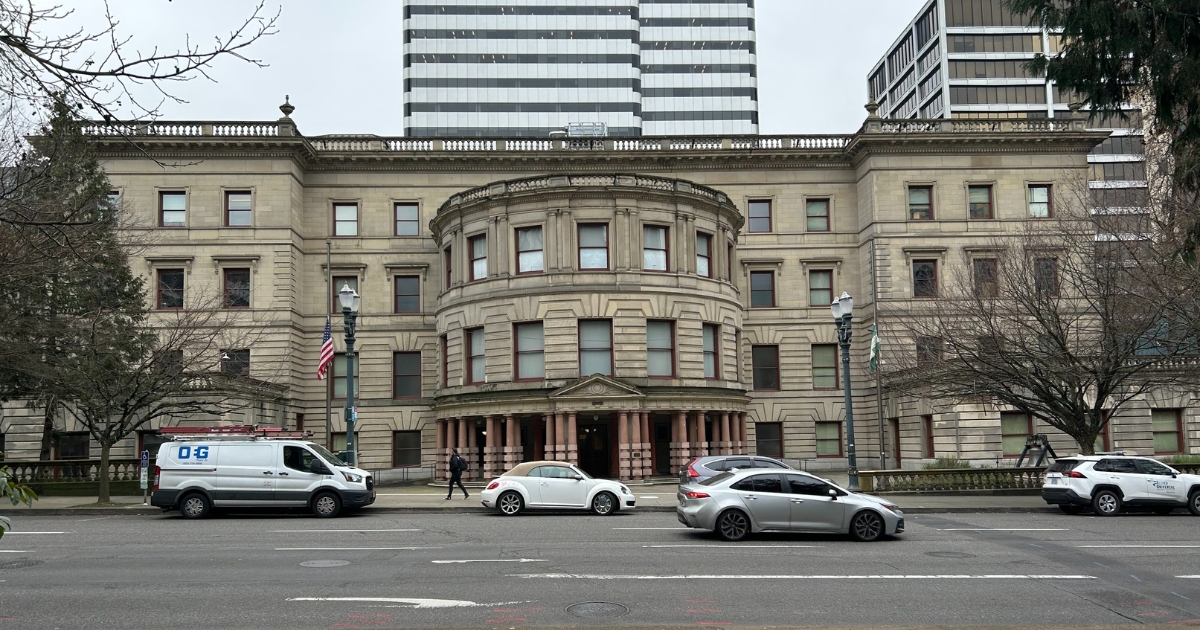
Officials say the goal is consistency, though Portland residents across SE Portland and the Pearl District report they are still trying to determine what consistency might physically resemble.
PORTLAND, OR — In what city officials are describing as a “comprehensive recalibration of expectation-aligned sanitation timelines,” the Portland City Council confirmed Tuesday that it has begun reviewing its current policy governing how quickly homeless encampments are cleared, relocated, reappeared, and subsequently re-reviewed by additional task forces.
The review, which officials say could take anywhere from three weeks to “several meaningful seasons,” aims to create what the city calls more predictable encampment cleanup timelines, though early discussions suggest that predictability may primarily apply to the review process itself rather than to the encampments.
According to preliminary briefing documents, the city hopes to produce “geographically confident data regarding the temporal behavior of tents.”
City Officials Emphasize Need for “Consistency Framework”
During a press briefing outside Portland City Hall, officials explained that the policy review is intended to create a unified framework for how encampment reports move through the city’s existing reporting systems, which currently include PDX Reporter, internal sanitation dashboards, several spreadsheets, and at least one dry-erase board.
Deputy Infrastructure Coordination Manager Lisa Harmon said the city is attempting to better align “narrative-based expectations with operational reality.”
“Residents often ask how long it takes for an encampment cleanup,” Harmon said. “Right now the answer can range anywhere from 48 hours to the amount of time it takes a moss patch to establish emotional roots.”
City analysts estimate that 93.8% of cleanup timelines are currently influenced by factors categorized internally as “situational.”
These factors include staffing, weather, contractor availability, whether the encampment is located next to a bike lane, and the presence of particularly photogenic tarps.
Neighborhoods Report Confusion About What “Consistent” Means
Across Portland neighborhoods—from SE Division Street to St. Johns and the edges of the Pearl District—residents say they support the idea of consistent policy but remain unclear how it will appear in daily life.
“I’m not asking for miracles,” said Hawthorne resident Mark Delaney, who says an encampment near a bus stop has been cleared three times in the past year. “I just want to know if the system runs on weeks, months, or vibes.”
Delaney explained that the cleanup schedule currently feels “philosophical.”
“Sometimes it’s gone in a week,” he said. “Sometimes the city studies it. Sometimes a different tent appears that seems more committed to the location.”
Residents near Burnside Street reported similar uncertainty.
One Pearl District condo owner said she initially believed a cleanup had occurred last fall before realizing the tents had simply rotated “ninety degrees toward the bike lane.”
City Survey Suggests Residents Mostly Aware of Tents
As part of the review, city analysts released a brief internal survey measuring public awareness of encampments across Portland.
The survey found that 94% of Portland residents reported being “generally aware that tents exist somewhere nearby.”
Another 61% said they could identify at least one tent location without consulting a map, while 27% said they had developed “a working relationship” with a specific tarp.
Officials described these findings as a valuable form of hyperlocal engagement data.
Urban planning consultant Rachel Velez said the city views this as evidence that “infrastructure remains present, even when the infrastructure is a tent.”
“The important thing is understanding how people interact with the landscape,” Velez said. “Right now that landscape includes tents, bike racks, and extremely thoughtful yard signs.”
TriMet Riders Report “Rotating Encampment Geography”
Transportation planners also noted that encampments near TriMet bus stops and MAX stations present unique logistical challenges because they often move slightly during cleanup cycles.
Transit riders along SE Foster Road say they have begun tracking these movements in informal ways.
“One tent was by the stop last winter, then across the sidewalk in spring, then back near the bench,” said commuter Denise Alvarez. “At this point it feels like seasonal migration.”
TriMet officials confirmed that while tents occasionally shift location after cleanups, bus routes remain unchanged, ensuring that “transportation infrastructure continues to exist in the general vicinity.”
Policy Review May Include “Encampment Lifecycle Mapping”
According to city staff, one proposal under consideration would involve creating a citywide “Encampment Lifecycle Map.”
The map would track the movement of individual encampments across Portland neighborhoods over time.
Officials say this could help determine whether certain tents are:
• newly established
• returning to a previous site
• “spiritually continuous with a prior tarp configuration.”
Urban planners say early modeling shows that several encampments appear to follow circular relocation patterns roughly matching Portland’s network of bike lanes.
“This suggests the tents are responding to the same infrastructure cues as cyclists,” one report noted.
City Promises Clear Timeline For Timeline Policy
Officials say a formal recommendation on the cleanup policy will be presented to the City Council later this year, though the timeline itself remains under review.
“We want residents to know we are committed to creating a consistent process,” Harmon said.
She added that the city is also reviewing how residents submit encampment reports, noting that multiple reporting platforms currently generate “parallel awareness streams.”
“Our goal,” Harmon said, “is to ensure that every report enters a system where it can be acknowledged, analyzed, and thoughtfully positioned within a broader narrative framework.”
Residents Say They Will Continue Observing Situation
For now, many Portland residents say they will continue monitoring the situation as it unfolds across the city.
Standing near a tent cluster off SE Division, Delaney said he plans to wait for the new policy before forming strong opinions.
“I assume the city is figuring something out,” he said. “Right now it feels like the tents, the reports, and the cleanups are all participating in the same long conversation.”
He paused and looked down the block.
“To be fair,” Delaney added, “this particular tent has been here longer than the coffee shop that replaced the previous coffee shop.”